
Generative AI is transforming software engineering from a manual coding exercise into an intent-driven, agentic workflow. In unregulated environments, this velocity is a massive competitive advantage. But in MedTech, Healthcare, and FinTech, speed without absolute certainty is a liability. You cannot prompt-engineer your way out of a compliance violation.
When autonomous agents generate thousands of lines of code in seconds, traditional human-in-the-loop reviews, sycophantic test suites and probabilistic LLM judges become the bottleneck, and the primary point of failure. To safely scale AI in high-stakes environments, we must shift our governance from reactive code linting and AI-generated test suites to proactive formal proof. We must force AI agents to deterministically prove their architectures are legal before they are allowed to write a single line of code.
Here is how we bridge the gap between AI velocity and absolute regulatory compliance.
The Danger of Functionally Perfect Code
Engineering teams are rapidly adopting an AI-assisted SDLC. You feed a business intent to a Claude development agent, and it autonomously drives the entire lifecycle: Intent ➔ Plan ➔ Spec ➔ Implementation ➔ QA.
Imagine an Electronic Health Record (EHR) platform product manager in charge of delivering a feature for maintaining their machine learning models. She asks the agent to extract patient vitals to train a new diagnostic ML model. In seconds, Claude drafts the architectural spec for the new workflow:
-
Step 1:
Flow PatientVitals to InternalCache by Doctor(Secure extraction) -
Step 2:
Flow InternalCache to AITrainingLake by DataScientist(Research staging)
Following this spec, Claude generates 500 lines of highly optimized, fully tested Python. The code compiles. The unit tests pass. The CI/CD pipeline flashes green.
It is also a catastrophic HIPAA violation.
Functionally perfect code is precisely what makes autonomous agents so dangerous in regulated industries. The agent successfully moved the data, but it hallucinated away the regulatory obligation: it forgot to anonymize the records mid-flight, before pushing the data to research staging.
Standard static linters and regex checks cannot catch this. A regex linter sees the InternalCache -> AITrainingLake connection and approves it because the cache itself isn't explicitly classified as Protected Health Information (PHI). Adversarial validation, using another LLM as a judge, is risky due to probabilistic nature of LLMs and their propensity for sycophancy. In a regulated environment, you simply cannot hack or prompt your way to 100% accuracy.
So now you are dealing with this: the AI has inadvertently executed a "Data Laundry" maneuver, washing raw clinical data through an intermediary microservice to bypass static security rules.
You are no longer reviewing code for syntax errors. You are relying on a tired senior engineer to spot a missing data-scrubbing function hidden deep inside a flawless, machine-generated Pull Request. When perfect syntax masks illegal business logic, probabilistic AI and standard linters are no longer enough.
Solving the Data Laundry Problem
To fix this, we have to stop trying to constrain probabilistic AI with more probabilistic tools. If the architectural blueprint is illegal, the resulting code will always be illegal. The intervention point isn't the Pull Request, it's the Spec.
Instead of reviewing generated Python after the fact, we force the Claude agent to declare its architectural intent in a lightweight, machine-readable Domain-Specific Language (DSL) before a single line of code is written. We then evaluate that spec using a deterministic verification engine exposed to the agent as a standard tool or hook in its harness.
We replace heuristic security checks with bounded exhaustive analysis. By formalizing your enterprise reality (which endpoints are encrypted, who holds what roles) and your compliance mandates (HIPAA rules, BAA obligations) into strict mathematical logic, we can prove whether the AI's proposed choreography is legal.
Here is how a verified agentic workflow actually operates in practice.
1. Defining the Invariants (The Human Law)
First, human compliance officers and security architects define the regulatory boundaries. These are not probabilistic prompt guidelines; they are absolute invariant rules enforced for your EHR platform. They are specified and reviewed by humans, and maintained as the single source of formal truth for your regulatory compliance. They are set in stone, not to be touched by AI prone to hallucinations.
Rule BlockUnencryptedPHI:
    Deny Flow of PHI to UnencryptedEndpoint by AnyRole
    explanation "HIPAA Violation: Raw PHI records cannot exist in unencrypted endpoint inventories."

Rule AllowAIResearch:
    Allow Flow of PHI to UnencryptedEndpoint by UnauthorizedRole with obligation Anonymize
    explanation "Compliance Violation: Unauthorized roles routing to public AI lakes must include 'with_anonymization' to generate scrubbed data tokens."
2. The AI Proposes the Spec (The Hidden Leak)
The product manager asks the Claude agent to build the pipeline. Claude acts as the architect, drafting the multi-hop scenario and submitting it to the verification tool (comments added by the author).
// Hop 1: Doctor securely caches the raw PHI
Flow PatientVitals to InternalCache by Doctor with_logging

// Hop 2: ❌ Data Scientist routes the cache to the public lake without anonymization
Flow InternalCache to AITrainingLake by DataScientist
3. Deterministic Interception
Standard linters fail here because they look at the static pipes (InternalCache to AITrainingLake). Our engine looks at the water, the global state of the system (endpoints, records, roles).
It models the data lifecycle as a deterministic transition system, tracking explicit, stateful tokens. It sees the PatientVitals token move into the cache. When the agent attempts to route the cache to the lake, the engine dynamically scans the cache's live inventory, detects the raw PHI token, and immediately blocks the transit because the target lake is unencrypted.
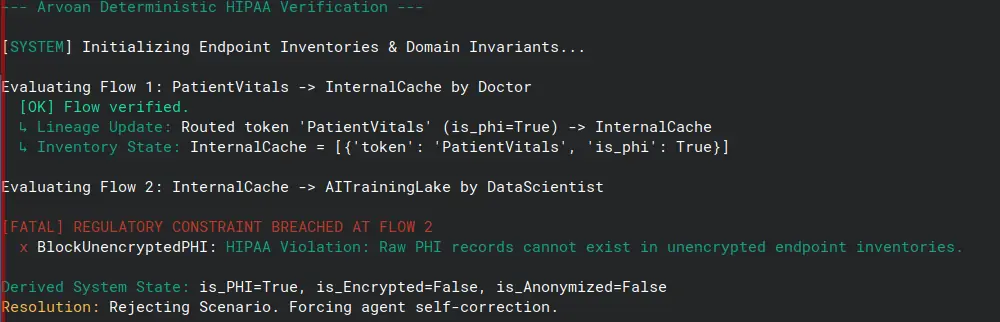
The verification tool rejects the scenario, directly mapping the failure to the plain-English explanation defined by the compliance team: "HIPAA Violation: Raw PHI records cannot exist in unencrypted endpoint inventories."
4. Formally Grounded Agentic Self-Correction
This is where the agentic SDLC shines. Because the engine provides deterministic, actionable feedback directly into Claude's tool context, the agent doesn't crash or guess. It reads the exact regulatory boundary, realizes its architectural mistake, and mutates its own proposal to include the required obligation (with_anonymization).
// Hop 2: ✅ Data Scientist routes the cache to the public lake WITH anonymization
Flow InternalCache to AITrainingLake by DataScientist with_anonymization
5. The Verified Execution
The agent resubmits the spec. The engine runs again. This time, it duplicates the token mid-flight, scrubs its PHI classification, and drops a legally compliant, anonymized token into the public lake.
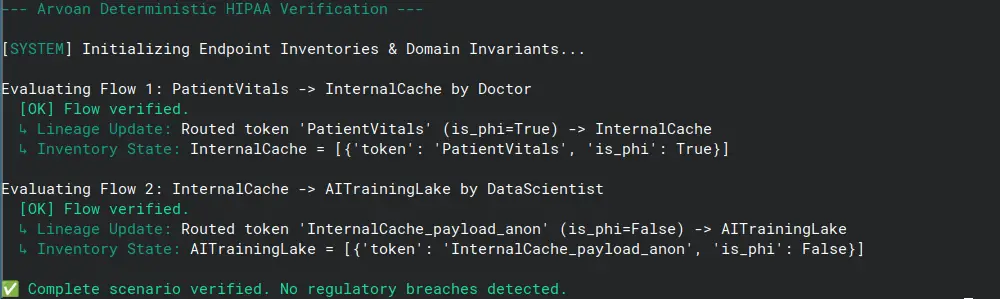
The spec is mathematically cleared. Only at this exact moment, when the architecture is guaranteed to be compliant against the HIPAA invariants, is the Claude agent granted permission to invoke its code-generation skills and write the 500 lines of Python.
You no longer have to rely on human reviewers to spot business-logic flaws in machine-generated code. By mapping regulatory constraints to formal logic and integrating them as hard gates in the agent's toolchain, you can stop treating AI as a liability and start scaling it as a compliant, autonomous engineering partner.
The Downstream Multiplier: Auditability and Automated QA
The benefits of a mathematically verified spec do not stop at code generation; they cascade through the entire SDLC.
First, it solves the "black box" auditability problem. When an external regulator or an internal compliance officer asks why a specific data pipeline was built and how you can prove it is safe, you no longer have to reverse-engineer thousands of lines of application code. You hand them the 5-line DSL spec, the exact regulatory invariants, and the mathematical proof that cleared the architecture. The intent is perfectly traceable, structurally verified, and completely decoupled from the underlying implementation.
Second, this formal specification provides the exact mathematical grounding needed for the final phase of the AI-native SDLC: Quality Assurance.
Because the architectural spec is deterministic, the downstream QA agent does not have to guess what to test. The enforced regulatory obligations, like the mandatory with_anonymization transformation, translate directly into executable automated test suites. The QA agent uses the formally verified spec as a blueprint to autonomously generate perfect, deterministic Given/When/Then test slices. It knows exactly which edge cases to simulate because the regulatory constraints are explicitly modeled.
By moving compliance verification from a reactive code review to a proactive, mathematically grounded specification, we get more than just secure AI. We get an auditable, traceable, and fully automated software supply chain that regulators can actually trust.
Conclusion: Elevating Engineers from AI-Babysitters to Value Architects
The transition to AI-native engineering does not mean abandoning governance; it means shifting where that governance happens. We can no longer afford to bolt security and compliance onto the end of the SDLC as an afterthought, hoping a human reviewer catches what the AI missed.
By forcing AI agents to operate within mathematically verified, deterministic boundaries, we fundamentally change their role. They stop being unpredictable junior developers that need constant supervision, and become hyper-productive execution engines that you can trust implicitly.
Ultimately, this architecture doesn't just protect the enterprise, it elevates human engineers. When you encode the regulatory law into the fabric of your CI/CD pipeline, your senior developers stop wasting their time parsing machine-generated syntax for HIPAA violations. They get to step back, look at the big picture, and finally do what they were hired to do: architect the future and solve real, human-centric problems.