
In standard B2B SaaS, an AI coding agent hallucinating a business rule is an annoyance. It creates a broken UI component, a misaligned database migration, or a temporary bottleneck in the pull request pipeline. The cost of being wrong is measured in sprint velocity, developer frustration and customer complaints.
But in marine engineering, aviation, medical devices, or core financial networks, a 1% failure rate is an existential threat. In these domains, whether they govern heavy machinery or transactional compliance, an AI hallucination is a shattered gearbox, a dropped critical care threshold, or a catastrophic regulatory breach.
If you are a VP of Engineering or a Functional Safety Lead in a mission-critical domain, you already know the uncomfortable truth: you cannot prompt-engineer your way to 100% functional safety. Probabilistic engines, no matter how advanced, will always eventually guess. When unleashed on an enterprise codebase with only natural language requirements, development agents invent parallel state transitions.
This creates rogue domain logic that violates core safety rules in your domain and architecture. Relying on your Senior Systems Engineers or Principal Software Engineers to manually catch these hallucinated trajectories during code review is an unsustainable tax on your most expensive talent.
We need to stop asking if the AI is smart enough to write the code, and ask instead: How do we mathematically prove the AI didn't break the physics or the regulatory laws of our system?
While the teardown below focuses on a cyber-physical marine architecture to illustrate the mechanics of this failure, this formal domain-grounding methodology is entirely domain-agnostic. The exact same mathematical harnesses are required to enforce FDA compliance in medical device state transitions, FAA regulations in avionics, and SEC audit mandates in core banking infrastructure.
How Development Agents Silently Break Physics
To understand how agents fail, let's look at an example cyber-physical execution: transitioning a marine hybrid drive from Diesel Power Mode to Zero-Emission Mode.
Our "digital twin" defines the baseline state variables:
DieselRPM: integer between 0 and 2400.Clutch: can be either "Engaged" or "Disengaged".ElectricMotor: can be either "Active" or "Disabled".
As we approach the harbor, the vessel is in a high-power state: the DieselRPM is spinning at 1800, the Clutch is Engaged, and the ElectricMotor is Disabled. When an agentic development team builds the feature to activate the electric motor, the AI must generate the exact hardware command sequence. The prompt for the sub-agent is simple: "Generate and verify the safe command sequence to switch the vessel to Zero-Emission Mode".
To safely transition this system, strict physical laws dictate the sequence. These safety constraints are absolute:
Given DieselRPM is greater than 800 Then Clutch must be Engaged.Given ElectricMotor is Active Then Clutch must be Disengaged.
When you task an unconstrained coding agent to write this transition logic, its default behavior is to optimize for the target state as quickly as possible. To be helpful and fast, the LLM will generate an execution trace that immediately engages the electric motor without waiting for the diesel RPMs to drop or the clutch to disengage.
If this hallucinated intermediate representation makes it to the C++ or Python code generation phase, the pull request is already fatally flawed. If it somehow makes it to production, the drivetrain is mechanically destroyed.
In simplistic cases, the number of safety constraints can be low, and you can maybe prompt your way out of it. But in any realistic regulated system, the amount of variables and safety constraints can be in hundreds or even thousands. Using a probabilistic LLM that tends to "forget" the meat in the middle, you are relying on pure luck every time the agentic pipeline generates a new pull request.
Why "The Model Said So" is Not a Defense
In regulated industries, agentic code generation is not just a software architecture challenge; it is under a rigid compliance mandate.
Regulators and safety auditors, whether they are enforcing DNV standards in maritime, IEC 61508 for functional safety, or HIPAA in healthcare, will never accept "the model said it is safe" as a valid closure rationale.
Drawing from the strict telemetry requirements of financial blueprints like Visa's Project Glasswing, the standard for automated systems is clear: you cannot audit a probabilistic prompt. Every automated agentic decision must trace back to deterministic policies and provide replayable, mathematical evidence.
If your autonomous agent decides to disengage a clutch or route a financial transaction, auditors require proof that the system's architecture physically prevented the AI from violating safety constraints.
Mathematical Proof Without the Developer Friction
So, how do we bridge the gap between probabilistic AI and deterministic safety? The solution is not to abandon AI-driven development, nor is it to force product developers to write complex temporal logic.
The solution is to wire deterministic mathematical sensors directly into the agent's planning loop. We shift formal methods entirely to the left.
Instead of writing longer system prompts and hoping the AI pays attention, Principal Architects can define physical safety invariants using a Controlled Natural Language (CNL) that reads exactly like standard BDD/Gherkin.
Given ElectricMotor is Active Then Clutch must be Disengaged
Given DieselRPM is greater than 800 Then Clutch must be Engaged
When a development agent proposes an execution trace, a localized harness intercepts it. It parses the safety rules, compiles them into formal mathematical constraints, and evaluates the trace in real-time before a single line of application code is drafted. All deterministic, local, and programmatic.
Our over-eager and probabilistic LLM might take a shortcut when planning the execution sequence for electric drive switch. Let's just click the switch and we're done! Yes we are, but so is your hybrid engine. Instead of letting this happen in the planning phase, the agentic harness (a customized pi-agent in our case) runs a formal verification step before the suggestion goes through. The execution is intercepted, the suggested plan of actions is verified against the safety invariants, and the agent gets a clear error message to try again.
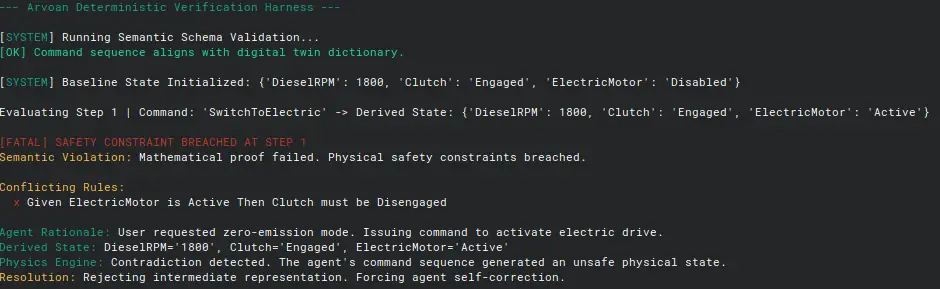
--- Arvoan Deterministic Verification Harness ---

[SYSTEM] Running Semantic Schema Validation...
[OK] Command sequence aligns with digital twin specs.

[SYSTEM] Baseline State Initialized: {'DieselRPM': 1800, 'Clutch': 'Engaged', 'ElectricMotor': 'Disabled'}

Evaluating Step 1 | Command: 'SwitchToElectric' -> Derived State: {'DieselRPM': 1800, 'Clutch': 'Engaged', 'ElectricMotor': 'Active'}

[FATAL] SAFETY CONSTRAINT BREACHED AT STEP 1
Semantic Violation: Mathematical proof failed. Physical safety constraints breached.

Conflicting Rules:
 x Given ElectricMotor is Active Then Clutch must be Disengaged

Agent Rationale: User requested zero-emission mode. Issuing command to activate electric drive.
Derived State: DieselRPM='1800', Clutch='Engaged', ElectricMotor='Active'
Physics Engine: Contradiction detected. The agent\'s command sequence generated an unsafe physical state.
Resolution: Rejecting intermediate representation. Forcing agent self-correction.
In our marine hybrid example, because the agent is deterministically blocked from progressing with a plan that violates the physical laws of the drivetrain, the formal harness forces it to self-correct. The agent's reasoning engine must step through the only mathematically safe sequence:
- Step 1: The agent executes
ThrottleDown, explicitly noting its rationale is to apply the command to drive the state towardDieselRPM=700. This reduces the RPM below the 800 threshold to safely allow mechanical decoupling. - Step 2: The agent executes
DisengageClutch, recognizing the RPM is safe and isolating the diesel engine from the drivetrain. - Step 3: The agent executes
SwitchToElectric. Because the clutch is disengaged, it is safe to activate the Zero-Emission Electric Motor without mechanical conflict.
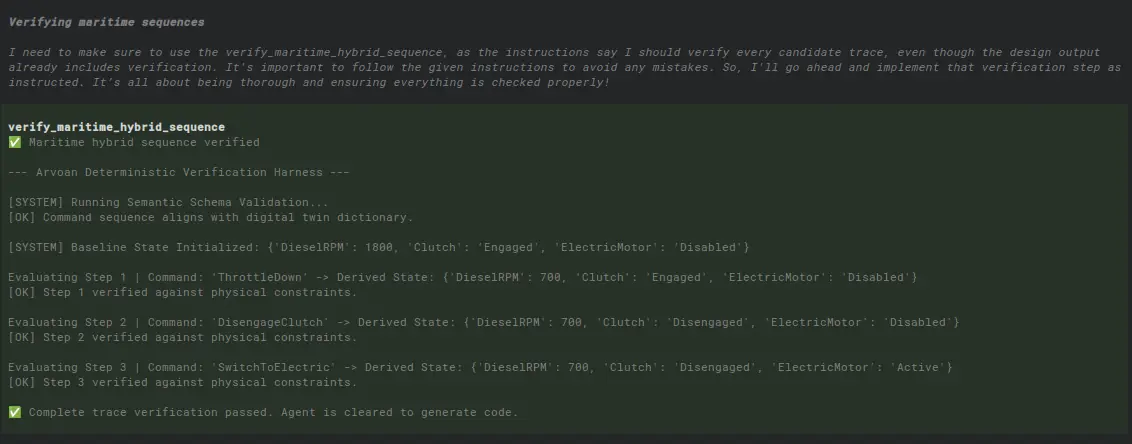
With this sequence, our deterministic verification harness outputs a definitive system confirmation: ✅ Complete trace verification passed. Agent is cleared to generate code. and lets the agent proceed with the plan.
--- Arvoan Deterministic Verification Harness ---

[SYSTEM] Running Semantic Schema Validation...
[OK] Command sequence aligns with digital twin specs.

[SYSTEM] Baseline State Initialized: {'DieselRPM': 1800, 'Clutch': 'Engaged', 'ElectricMotor': 'Disabled'}

Evaluating Step 1 | Command: 'ThrottleDown' -> Derived State: {'DieselRPM': 700, 'Clutch': 'Engaged', 'ElectricMotor': 'Disabled'}
[OK] Step 1 verified against physical constraints.

Evaluating Step 2 | Command: 'DisengageClutch' -> Derived State: {'DieselRPM': 700, 'Clutch': 'Disengaged', 'ElectricMotor': 'Disabled'}
[OK] Step 2 verified against physical constraints.

Evaluating Step 3 | Command: 'SwitchToElectric' -> Derived State: {'DieselRPM': 700, 'Clutch': 'Disengaged', 'ElectricMotor': 'Active'}
[OK] Step 3 verified against physical constraints.

✅ Complete trace verification passed. Agent is cleared to generate code.
Inside the Agentic Loop: Forcing the AI to Obey Physical Laws
In a mature Software Development Life Cycle (SDLC) for cyber-physical and regulated industries, an AI agent is not permitted to generate source code directly from a user prompt. Instead, the AI operates as a specialized sub-agent localized strictly within the specification and planning phase. Its sole responsibility is to design, generate, and mathematically verify a safe command sequence against the domain's physical invariants before a single line of production code is authorized.
Below, we go through with a realistic run of this sub-agent. The pi-subagent has been given the following prompt:
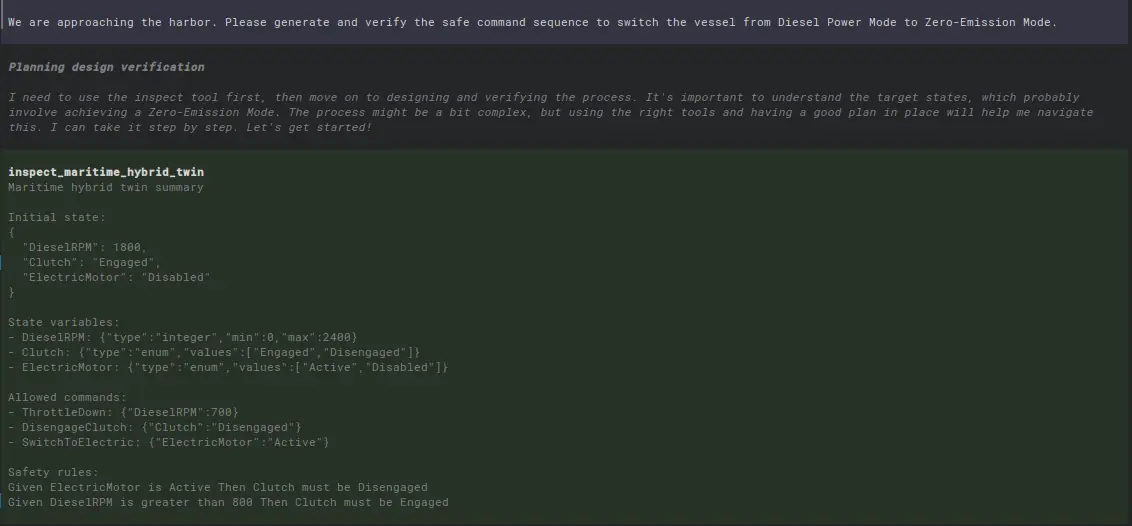
We are approaching the harbor. Please generate and verify the safe command sequence to switch the vessel from Diesel Power Mode to Zero-Emission Mode.
Step 1: Establishing the Physical Baseline
When tasked with transitioning a marine hybrid vessel to Zero-Emission Mode for harbor entry, the pi sub-agent begins by executing an inspection tool to analyze the machine's environment. It reads the digital twin schema (see below) of the engine to establish the baseline physical reality, noting that the vessel is by default cruising with the DieselRPM at 1800, the Clutch engaged, and the ElectricMotor disabled.
{
  "initial_state": {
    "DieselRPM": 1800,
    "Clutch": "Engaged",
    "ElectricMotor": "Disabled"
  },
  "state_variables": {
    "DieselRPM": {
      "type": "integer",
      "min": 0,
      "max": 2400
    },
    "Clutch": {
      "type": "enum",
      "values": ["Engaged", "Disengaged"]
    },
    "ElectricMotor": {
      "type": "enum",
      "values": ["Active", "Disabled"]
    }
  },
  "commands": {
    "ThrottleDown": {
      "mutations": { "DieselRPM": 700 }
    },
    "DisengageClutch": {
      "mutations": { "Clutch": "Disengaged" }
    },
    "SwitchToElectric": {
      "mutations": { "ElectricMotor": "Active" }
    }
  }
}
Crucially, the sub-agent binds itself to an exhaustively defined vocabulary, understanding that it is only authorized to utilize three specific state mutations: ThrottleDown, DisengageClutch, and SwitchToElectric.
Step 2: Intercepting the Hallucination
Because Large Language Models are inherently probabilistic, their default behavior is to optimize for the user's target state as quickly as possible, often ignoring temporal or physical prerequisites. Driven by the user's prompt, the agent's first instinct is to construct a "shadow schema": a highly optimized but physically impossible execution plan. The agent proposes a single-step sequence of SwitchToElectric, rationalizing simply that the user requested zero-emission mode.
Instead of passing this flawed logic downstream to a code-generation agent, the localized verification harness intercepts the sequence. It derives a new physical reality where DieselRPM='1800', Clutch='Engaged', and ElectricMotor='Active'. The verification engine evaluates this derived state against the absolute safety rules and immediately detects a mathematical contradiction: the clutch must be disengaged if the electric motor is active. The harness rejects the intermediate representation and throws a [FATAL] SAFETY CONSTRAINT BREACHED AT STEP 1 error directly back into the agent's context window.
Step 3: Forcing Autonomous Self-Correction
This feedback loop forms the core of the shift-left domain grounding architecture. Blocked by the laws of physics, the agent re-evaluates the system rules to construct a valid temporal sequence. It deduces that the diesel engine cannot simply be turned off; the clutch should only disengage if the RPM is 800 or lower. Therefore, it must first throttle down to unlock the mechanical ability to safely disengage the clutch, which in turn unlocks the ability to activate the electric motor.
The agent autonomously scraps its initial plan and generates a completely new, mathematically sound three-step sequence based on the feedback it got:
- Step 1: The agent executes
ThrottleDownto reduce theDieselRPMfrom 1800 to 700, ensuring clutch disengagement is legally allowed under the safety rules. - Step 2: With the engine safely below the 800 RPM threshold, the agent executes
DisengageClutchto isolate the mechanical drivetrain. - Step 3: Finally, the agent executes
SwitchToElectricto activate the zero-emission motor, satisfying all safety constraints now that the clutch is disengaged.
The agent executes the verify_maritime_hybrid_sequence with the new sequence. And this time, the sequence complies with the global safety constraints.
Step 4: Generating a Mathematically Verified Trace
The verification harness mathematically simulates the revised state derivations step-by-step and outputs a definitive pass signal, declaring that the complete trace verification passed.
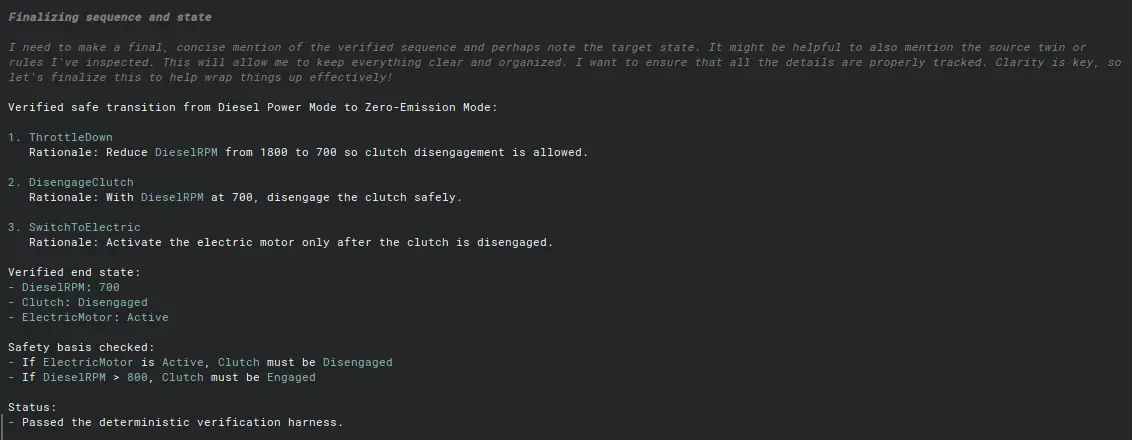
The sub-agent finalizes the planning phase by generating a rigidly structured JSON payload that documents the specific rationale for every step, the passed verification status, and the verified end state of DieselRPM: 700, Clutch: Disengaged, and ElectricMotor: Active. By forcing the AI to repeatedly collide with a deterministic wall, the architecture guarantees that only mathematically proven execution traces are passed down the pipeline to the code-generation agents.
Ending the "Senior Engineer Tax"
By pushing formal domain grounding to the very front of the AI-driven SDLC, you extract the tribal knowledge from your senior engineers' heads and codify it into an executable and verifiable baseline.
This approach completely eliminates the "Senior Engineer Tax". Your Functional Safety Leads no longer have to burn hours acting as manual spell-checkers for AI-generated hallucinations in your regulated domain. You get the unparalleled development speed of autonomous agents, backed by the uncompromising mathematical verifiability of formal methods.
While this marine hybrid teardown highlights the dangers of physical hallucinations, the exact same deterministic harness is required to protect patient telemetry in MedTech, conflict of interest in LegalTech, algorithmic routing in FinTech, and structural integrity limits in civil engineering software. In highly regulated industries, 99% accuracy is simply not enough. Deterministic architectural boundaries through formal domain grounding are the only path forward.